

-
1 structural steel framework
English-German dictionary of Architecture and Construction > structural steel framework
-
2 structural framework steel
English-german technical dictionary > structural framework steel
-
3 structure
здание
Наземное сооружение с помещениями для проживания, деятельности людей, хранения сырья или продукции или содержания животных.
[Терминологический словарь по строительству на 12 языках (ВНИИИС Госстроя СССР)]
здание
Наземное строительное сооружение с помещениями для проживания и (или) деятельности людей, размещения производств, хранения продукции или содержания животных
[ ГОСТ Р 52086-2003]
здание
Строительная система, состоящая из несущих и ограждающих или совмещенных несущих и ограждающих конструкций, образующих наземный замкнутый объем, предназначенный для проживания или пребывания людей в зависимости от функционального назначения и для выполнения различного вида производственных процессов.
[РД 01.120.00-КТН-228-06]
здание
Покрытая крышей конструкция со стенами, в которой энергия применяется для создания определенных условий внутри помещения. В качестве здания может рассматриваться здание целиком или его часть, спроектированная или перестроенная для отдельной эксплуатации.
[ДИРЕКТИВА 2002/91/ЕС ЕВРОПЕЙСКОГО ПАРЛАМЕТА И СОВЕТА от 16 декабря 2002 г. по энергетическим характеристикам зданий]
здание
Результат строительства, представляющий собой объемную строительную систему, имеющую надземную и (или) подземную части, включающую в себя помещения, сети инженерно-технического обеспечения и системы инженерно-технического обеспечения и предназначенную для проживания и (или) деятельности людей, размещения производства, хранения продукции или содержания животных.
[Технический регламент о безопасности зданий и сооружений]
здание
Результат строительства, представляющий собой объемную строительную систему, имеющую надземную и (или) подземную части, включающую в себя помещения, сети и системы инженерно-технического обеспечения и предназначенную для проживания и (или) деятельности людей, размещения производства, хранения продукции или содержания животных [4].
Примечание - Данное определение может относиться к зданию в целом или к отдельным частям здания, которые могут использоваться отдельно.
[ ГОСТ Р 54860-2011]- Промышленные здания
-
Общественные здания
-
учреждения и организации управления, финансирования, кредитования, госстраха, просвещения, дошкольные;
- библиотеки, архивы;
- предприятия торговли, общепита, бытового обслуживания населения;
- гостиницы;
- лечебные учреждения;
- музеи;
- зрелищные предприятия и спортивные сооружения
-
учреждения и организации управления, финансирования, кредитования, госстраха, просвещения, дошкольные;
- Жилые здания
Части здания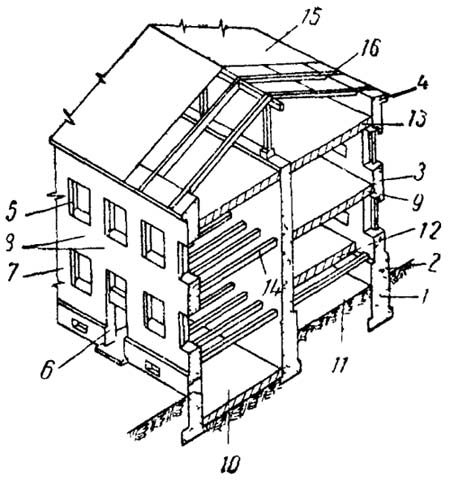
1 - фундамент;
2 - цоколь;
3 - поле стены (лицевая поверхность стены);
4 - карниз;
5 - оконный проем;
6 - дверной проем;
7 - простенок;
8 - перемычка (часть стены, перекрывающая оконные или дверные проемы);
9 - междуэтажное перекрытие;
10 - подвал;
11 - подполье;
12 - нижнее перекрытие;
13 - чердачное перекрытие;
14 - балки;
15 - кровля;
16 - стропила;
(15+16) - крыша[Грингауз Ф.И. Слесарь-жестянщик по промышленной вентиляции. Госстройиздат, 1959. 264 стр.]
Тематики
- здания, сооружения, помещения
- магистральный нефтепроводный транспорт
- опалубка
- теплоснабжение зданий
- энергосбережение
EN
DE
FR
каркас
Каркас представляет собой часть корпуса НКУ, к которой крепят элементы оболочки (панели, крышку, дверь (или двери).
Несущая часть панели ВРУ, на которой крепятся аппараты функциональных блоков, а также элементы оболочки и внутренние защитные ограждения.
[ ГОСТ Р 51732-2001]
каркас НКУ
-
[Интент]
Каркас может быть:- сборный;
- частично сварной;
- полностью сварной.
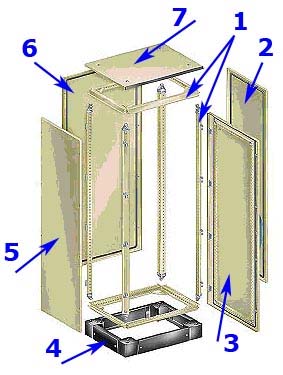
Корпус шкафа со сборным каркасом
-
элементы объемного сборного каркаса;
сборный каркас - боковая панель (правая панель);
- дверь;
- цоколь;
- боковая панель (левая панель);
- задняя панель;
-
крышка;
верхняя панель
Параллельные тексты EN-RU
Switchgear frame
The PC3.0/MNS R frame is based on modular 2 mm thick steel C sections, pre-drilled at a pitch of 25 mm DIN.
Each unit is based on modular elements and consists of:
• circuit-breaker compartments;
• instrument compartments;
• busbar compartment;
• cable compartment.
All compartments are mechanically segregated from the others.
[ABB]Каркас НКУ
Каркас PC3.0/MNS R изготовлен из модульного усиленного стального С-образного DIN-профиля толщиной 2 мм с отверстиями, расположенными с шагом 25 мм.
Каждый функциональный блок является модульным и включает в себя:
• отсеки автоматических выключателей;
• отсеки средств контроля, управления и защиты;
• отсек шин;
• кабельный отсек.
Все отсеки разделены перегородками или ограждениями друг от друга.
[Перевод Интент]Тематики
- НКУ (шкафы, пульты,...)
Синонимы
EN
FR
каркас стационарного котла
каркас
Ндп. котельный каркас
Несущая металлическая конструкция, воспринимающая нагрузку от массы стационарного котла, с учетом временных и особых нагрузок и обеспечивающая требуемое взаимное расположение элементов котла.
[ ГОСТ 23172-78]Недопустимые, нерекомендуемые
Тематики
- котел, водонагреватель
Синонимы
EN
DE
FR
конструкция
Устройство, взаимное расположение частей и состав машины, механизма или сооружения.
[ http://sl3d.ru/o-slovare.html]Параллельные тексты EN-RU
The new valve profile is design to ensure smooth and precise control at low capacities for improved part load performances.
[Lennox]Вентиль новой конструкции обеспечивает плавное и точное регулирование при низкой производительности холодильного контура, что увеличивает его эффективность при неполной нагрузке.
[Интент]
Тематики
EN
мн. здания
сооружения
—
[А.С.Гольдберг. Англо-русский энергетический словарь. 2006 г.]Тематики
Синонимы
EN
3.38 структура (structure): Порядок следования элементов данных в сообщении.
Источник: ГОСТ Р ИСО 22742-2006: Автоматическая идентификация. Кодирование штриховое. Символы линейного штрихового кода и двумерные символы на упаковке продукции оригинал документа
3.2.32 структура (structure): Набор взаимосвязанных частей какого-либо сложного объекта, а также взаимосвязей между ними;
Источник: ГОСТ Р ИСО 10303-1-99: Системы автоматизации производства и их интеграция. Представление данных об изделии и обмен этими данными. Часть 1. Общие представления и основополагающие принципы оригинал документа
4.43 структура (structure): Отдельное волокно, пучок волокон, сгруппированные волокна или матрица.
Источник: ГОСТ Р ИСО 16000-7-2011: Воздух замкнутых помещений. Часть 7. Отбор проб при определении содержания волокон асбеста оригинал документа
3.13 конструкция (structure): Организованная комбинация соединенных между собой элементов, выполняющих несущие, оградительные либо совмещенные функции.
Источник: ГОСТ Р 54483-2011: Нефтяная и газовая промышленность. Платформы морские для нефтегазодобычи. Общие требования оригинал документа
Англо-русский словарь нормативно-технической терминологии > structure
-
4 arrangement
1) расположение, размещение2) устройство; система3) предоставление (напр. кредита)•- arrangement of steel - atomic arrangement - credit arrangement - general arrangement - pipe arrangement - seal arrangement* * *1. расположение, размещение; расстановка2. устройство3. схема планировки (напр. улично-дорожной сети)- arrangement of beams
- arrangement of building components
- arrangement of framework
- arrangement of lines
- arrangement of reinforcement
- arrangement of structural members
- blasting arrangement
- column arrangement
- first-aid arrangement
- house-side luminaire mounting arrangement
- locking arrangement
- median luminaire mounting arrangement
- opposite luminaire mounting arrangement
- personnel arrangement
- rigging arrangement
- spacial arrangement of a building
- staggered luminaire mounting arrangement
- structural arrangement
- two-level arrangement of carriageways -
5 Sullivan, Louis Henry
SUBJECT AREA: Architecture and building[br]b. 3 September 1856 Boston, Massachusetts, USAd. 14 April 1924 Chicago, Illinois, USA[br]American architect whose work came to be known as the "Chicago School of Architecture" and who created a new style of architecture suited specifically to steel-frame, high-rise structures.[br]Sullivan, a Bostonian, studied at the Massachusetts Institute of Technology. Soon he joined his parents, who had moved to Chicago, and worked for a while in the office of William Le Baron Jenney, the pioneer of steel-frame construction. After spending some time studying at the Ecole des Beaux Arts in Paris, in 1875 Sullivan returned to Chicago, where he later met and worked for the Danish architect Dankmar Adler, who was practising there. In 1881 the two architects became partners, and during the succeeding fifteen years they produced their finest work and the buildings for which Sullivan is especially known.During the early 1880s in Chicago, load-bearing, metal-framework structures that made lofty skyscrapers possible had been developed (see Jenney and Holabird). Louis H.Sullivan initiated building design to stress and complement the metal structure rather than hide it. Moving onwards from H.H.Richardson's treatment of his Marshall Field Wholesale Store in Chicago, Sullivan took the concept several stages further. His first outstanding work, built with Adler in 1886–9, was the Auditorium Building in Chicago. The exterior, in particular, was derived largely from Richardson's Field Store, and the building—now restored—is of bold but simple design, massively built in granite and stone, its form stressing the structure beneath. The architects' reputation was established with this building.The firm of Sullivan \& Adler established itself during the early 1890s, when they built their most famous skyscrapers. Adler was largely responsible for the structure, the acoustics and function, while Sullivan was responsible for the architectural design, concerning himself particularly with the limitation and careful handling of ornament. In 1892 he published his ideas in Ornament in Architecture, where he preached restraint in its quality and disposition. He established himself as a master of design in the building itself, producing a rhythmic simplicity of form, closely related to the structural shape beneath. The two great examples of this successful approach were the Wainwright Building in St Louis, Missouri (1890–1) and the Guaranty Building in Buffalo, New York (1894–5). The Wainwright Building was a ten-storeyed structure built in stone and brick and decorated with terracotta. The vertical line was stressed throughout but especially at the corners, where pilasters were wider. These rose unbroken to an Art Nouveau type of decorative frieze and a deeply projecting cornice above. The thirteen-storeyed Guaranty Building is Sullivan's masterpiece, a simple, bold, finely proportioned and essentially modern structure. The pilaster verticals are even more boldly stressed and decoration is at a minimum. In the twentieth century the almost free-standing supporting pillars on the ground floor have come to be called pilotis. As late as the 1920s, particularly in New York, the architectural style and decoration of skyscrapers remained traditionally eclectic, based chiefly upon Gothic or classical forms; in view of this, Sullivan's Guaranty Building was far ahead of its time.[br]BibliographyArticle by Louis H.Sullivan. Address delivered to architectural students June 1899, published in Canadian Architecture Vol. 18(7):52–3.Further ReadingHugh Morrison, 1962, Louis Sullivan: Prophet of Modern Architecture.Willard Connely, 1961, Louis Sullivan as He Lived, New York: Horizon Press.DY
См. также в других словарях:
Fabrication of structural steel by plasma and laser cutting — Fabrication of dimensional (non flat) structural steel elements has historically been performed by sequential operations involving sawing, drilling and high temperature flame cutting to remove material. Each of these operations is performed on… … Wikipedia
Steel frame — usually refers to a building technique with a skeleton frame of vertical steel columns and horizontal I beams, constructed in a rectangular grid to support the floors, roof and walls of a building which are all attached to the frame. The… … Wikipedia
Cold formed steel — (CFS) is the common term for products made by rolling or pressing thin gauges of sheet steel into goods. Cold formed steel goods are created by the working of sheet steel using stamping, rolling, or presses to deform the sheet into a usable… … Wikipedia
Metal-organic framework — Metal Organic Frameworks are crystalline compounds consisting of metal ions or clusters coordinated to often rigid organic molecules to form one , two , or three dimensional structures that can be porous. In some cases, the pores are stable to… … Wikipedia
History of structural engineering — The history of structural engineering dates back to at least 2700 BC when the step pyramid for Pharaoh Djoser was built by Imhotep, the first engineer in history known by name. Pyramids were the most common major structures built by ancient… … Wikipedia
Ashfork-Bainbridge Steel Dam — The Ashfork Bainbridge Steel Dam, the first large steel dam in the world, and one of only 3 ever built in the United States, was constructed in 1898 by the Atchison, Topeka and Santa Fe Railway (ATSF) to supply water for railway operations near… … Wikipedia
Sky Tower — Infobox Skyscraper building name = Sky Tower caption = Looking up at the Sky Tower / Sky Tower lit up at night. year highest = year end = plural = location = Flagicon|New Zealand Auckland City, New Zealand status = groundbreaking = 1994… … Wikipedia
Memorial Coliseum (Corpus Christi) — The Memorial Coliseum of Corpus Christi, Texas, was situated on the bayfront and was demolished in June 2010. Contents 1 Dedication 2 Architecture 3 Photographs 4 Demolition … Wikipedia
Feldberg/Taunus transmitter — The Feldberg/Taunus transmitter is a facility for FM and TV broadcasting and for directional radio services.It is used for FM and TV broadcasting; a 116.17 metre high guyed mast is used as an antenna tower. It is located on the Großer Feldberg,… … Wikipedia
Scranton Cultural Center — Masonic Temple and Scottish Rite Cathedral U.S. National Register of Historic Places … Wikipedia
building construction — Techniques and industry involved in the assembly and erection of structures. Early humans built primarily for shelter, using simple methods. Building materials came from the land, and fabrication was dictated by the limits of the materials and… … Universalium
